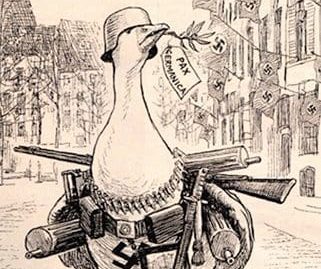
All too often when the students see political cartoons in textbooks they focus on an oval shape in the centre of the picture, often missing peripheral detail and occasionally ignoring the caption, punch line, date and author.
This lesson uses a technique, known to most of you, of breaking the image down part by part so that students gradually build and deepen their understanding in layers. Whilst this lesson focuses on visual images you could follow this up with an examination of key texts as suggested on the Learning Curve site of National Archives
Learning objectives
- students grasp the impact of the invasion of the Rhineland and can link it to what was happening in Abyssinia
- students learn to decode 3 contemporary cartoons, particularly looking for inferences
Starter
Explain that the lesson is going to deal with an event which Hitler described as the most nerve-wracking 2 days of his life.
Step 1
Explain the background, linking with work on Abyssinia, using the timeline on slide 2. Focus on the Mutual Assistance pact between Russia and France which gave Hitler a pretext. He argued that he should be allowed to place troops on his own frontier.
Explain that it was a gamble and that Hitler was anxious, even though the League was preoccupied with Abyssinia.
Step2
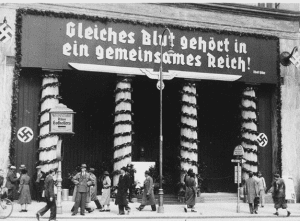
Look at the cartoon of the invasion of the Rhineland using PowerPoint slide number 3. Can students make sense of it? Show how it can be broken down, and then give each pair of students 3 minutes to come up with their analysis of the cartoon. Go through each step and then add the punch line, slide 7.
Step 3
Now ask the students to work as a team to script what one of them will say to camera in 5 minutes time. The reporter has only 30 seconds of air time. The student in role as foreign correspondent replies to the question. “People at home will be thinking it was a bit of a risk. How much of a risk was it?”
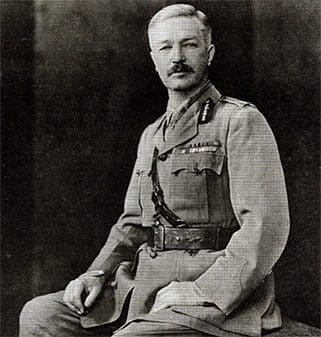
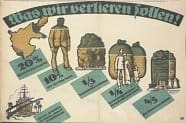
Each group has an envelope inside which are sources shown on slides 10-14 plus their textbooks. They have just 5 minutes to prepare their report.
Step 4
Reporters give their 30 second presentations. Depending on time, select 3-5 groups: no more, or it becomes tedious. Those groups who did not present are asked ‘Which was the best presentation?’
Step 5
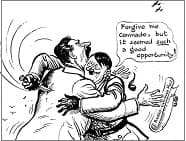
Return to the original PowerPoint and show slides 14 and 15 with their unseen cartoons. The slides have been carefully animated to reveal clues from the images in a particular sequence. You might want students to do their own annotations or simply to answer verbally, What was the reaction to Hitler’s invasion in the press?
Look for ideas such as: Unjustified; aggressive; pretending to be the innocent party etc.
Step 6
Students finish the lesson by completing a paragraph which follows the first line:Germany’s invasion of the Rhineland was an important event in the lead up to World War Two because……………..