
Assessment and Progression
 Effective assessment in KS3 history should do more than measure what pupils can remember. It should help teachers understand how well pupils are developing their historical knowledge, conceptual understanding and ability to think and work as historians, while also giving pupils clear guidance on how to improve.
This section provides practical guidance on assessment and progression across Years 7, 8 and 9. Explore the principles of effective history assessment, assessment for learning, designing meaningful assessment tasks, judging pupils’ work, pupil target setting and planning for progression across key historical skills and concepts. The aim is to help departments build assessment approaches that are manageable, purposeful and closely connected to the history curriculum.
Getting your KS3 assessment right in history: 12 step guide
You will know from the activities provided on the site that we are firm believers in a planned series of varied diagnostic tasks taken under test conditions which show how…
Read More
Assessment for Learning: 5 core strategies that work
Helps teachers to collect information about pupils’ achievement in order to adjust teaching to meet pupils’ learning needs more fully, through the implementation of five core strategies 5 core strategies…
Read More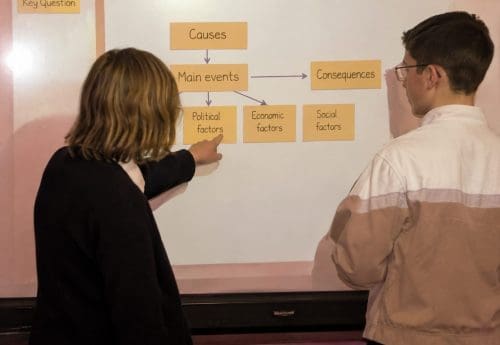
Progression in history at Key Stage 3
Most of you will have a fairly clear idea of what it means to ‘get better’ at history, and will have adjusted your schemes of work to ensure that the…
Read More
Pupil Target setting in history at Key Stage 3
I still find this aspect of assessment troublesome. The curricular targets present few problems: the numerical ones certainly do. I am happy that I know what I want to say…
Read More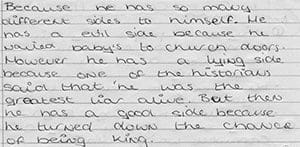
Judging pupils’ history work at KS3
Yes, it IS true. No more levels. Honest. What a weight off our minds. But be careful what you wish for. It still seems to be that many SLTs have…
Read More
Assessment tasks in Key Stage 3 history
The answer to key Stage 3 assessment in history This title is obviously tongue-in-cheek. Schools and departments must find their own preferred approach. So what I offer below is not…
Read More
Key Stage 3 teacher assessment: the 10 key principles
Most history departments were delighted to see the back of the crude and spurious NC levels. Instead of making as use these blunt instruments which have been misapplied to individual…
Read More
Progression in history – looking at specific strands
In this highly-rated post, with really important attachments, we show how it is even more important to get a really strong grasp of progression in all the main concepts. In…
Read MoreAssessment for learning in history at Key Stage 3
I have tried to be careful here not to reproduce the mass of material that has been provided by the DCSF as part of the National Strategy and the excellent…
Read MoreWritten by Neil Thompson

All content on Keystage history is written and quality assured by Neil Thompson, a former history teacher, county history adviser and Ofsted inspector with more than 30 years’ experience in history education.