This two part session gives the topic on the Vikings a really active start. Following an introduction to the Vikings in time and place, including a competitive Time Team task, pupils investigate stereotypical images of Vikings as a start to the overall enquiry.

The main fun part of the lesson is the reconstruction relay. Pupils are placed in role as Saxon spies who have to find out what makes the Vikings’ boats so special. After the fast and furious finding out there is a quieter thinking of questions section, followed by a hot seating activity.

What image do we have of the Vikings today?  Vikings Key Question 1

Learning objectives

  • Pupils are able to pick out three stereotypical features of images from today’s media and popular perceptions;
  • they know where the Vikings came from and why they attacked;
  • they know that the Vikings were a real threat from the sea;
  • they can relate the Vikings in time to the Roman and Anglo-Saxons;
  • the more able grasp that the initial period of raiding lasted just one short episode within a period of Viking contact with England that lasted nearly 3 centuries from 789 to 1066.

Part 1: Introduction to the Vikings

Step 1

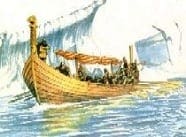
Display slide 2 showing a typical artist’s impression of a Viking raid. Ask pupils to generate a range of adjectives and nouns (colour coded) used to stereotype the Vikings using slide 2 from adverts from the Yellow pages to show how familiar the image has become in people’s minds today. You could extend this to include adverbs as well in a different colour.

Step 2

Now quickly place the Vikings in time and place. Use slides 4 and 5 to help focus a strong image in pupils’ minds. No recording here, keep the pace snappy and keep referring back to the slides (to remind pupils who need reinforcement) at appropriate moments. Quickly explain the motivation of the Vikings recapping how it was similar to the Saxons. Spend a little more time on the chronology as this will feature strongly throughout this topic.

Step 3

To reinforce the chronological aspect in a more active way, divide the pupils into TimeTeams of 4. I’d suggest mixed-ability to make it more competitive, to help pupils to work constructively and to enable the more able to cross teach those who need more one-to-one coaching. They are going to stay in these time teams all topic and will work together on Time tasks – from time to time, as it were! They are given a series of 15 statements about the length of time the Vikings were in Britain and how that related to the Roman and Saxon occupation. All they have to do is to work out if the statements are true or false. To make it more fun, add some tension. Have an audible clock ticking.

Record Time Team scores. This is a good way of getting over two key concepts regarding the passage of time: interval and duration. This helps pupils to work out if things happened quickly or slowly; so much more than just learning dates.

This much needed context is a warm-up for the main activity that follows.

Part 2: Reconstruction Relay

Learning objectives

  • Pupils learn to observe precise detail about Viking ships;
  • they raise high quality historical questions of their own;
  • they carry out simple research in preparation for hot seating.

Step 1 Scene setting

It is 815AD. You are a tribe of Saxons living on the Southern shores of Wessex. You are completely fed up with being attacked by the Vikings who seem to have particularly effective boats that manage to land in places you thought impossible and to sail up rivers ready to attack you. They have caused a lot of damage to your fellow Saxons. What is the secret of their success? Here is your chance to find out.

Step 2 Setting up the activity

You are to work in teams of four as Saxon spies. (Group sizes: four works best, if threes then it might be worth considering allowing one of the more boisterous pupils to be spy one and go again as spy 4, giving them more to do but also giving them the final refining role.)

Imagine the room is the shoreline. In 8 different parts of the room are Vikings ships which have been moored briefly. The Vikings have left their boats to explore inland, briefly. This is your chance to have a quick look at the features that make their boats so special. But we have to be quick. We mustn’t get caught. So it’s best if we go one at a time. You will each have just 10 seconds to look at the boat, 10 seconds to sketch it, and then 10 to brief the next spy what to look for. It adds greatly to the excitement if the teacher counts down from ten seconds, getting louder as you approach three, two, one STOP!

You have just one pencil, a rubber and a blank sheet of A3 paper. Leave all the materials on the table when you go to spy and always stop when the ten seconds is counted.

For safety’s sake, make sure that the A3 colour pictures of the boat (downloadable powerpoint slide 2 or the other image in the gallery if you prefer) are carefully positioned. Children will be excited by the speed and danger of the task so it is important to minimise their opportunities for them to collide. Place 2 pictures on each wall (i.e. 8 pictures in all) and have groups of 4 going in a straight line to the nearest picture so they never have to cross paths!

Step 3

So all the number ones go first and must talk to the number twos before they go off and sketch. It is important that pupils don’t feel too anxious about their drawing ability. They have only 10 seconds, its only a sketch, they can change things later and you are not looking at their work. What it should do is to make pupils excited and keen to share information and ideas. Some, indeed, can make good use of prior knowledge.

When all four spies have made a visit to the boat and all the drawings are ‘complete’, tell them that you have just spotted a Viking guard leaving his look out post. So they have just 25 seconds to make any last minute changes to the drawings together.

Step 4

Now, unusually, say that the Viking guard still hasn’t returned to the boat so we can all go to the shore and have an even closer look. Do this by returning the A3 sheets to each table and allow the pupils 1 minute to change any aspect they like.

Step 5

Now tell the pupils that you have managed to capture Sven a top boat builder who was on one of the boats. They will come looking for him soon, so we have only 2 minutes to think of the 5 best questions we can think of. You might model a good question to start off, but don’t steal too much of their thunder.

Step 6

Now collect all the good questions writing them on card which you stick on the board. You might have some of these pre-prepared to save time, and just add the original ones. As you stick the question cards to the board, ask the children to think about any that could be grouped or linked. We are now beginning to frame an enquiry. What were Viking boats really like?

Step 7

Now go into role as Sven. I have provided a crib sheet of a typical question and answer session to help you. You can begin to answer their questions. As you were only one of many men working on the design you cannot be expected to know everything, but it is fun if you try to stay in role.

Step 8

With many of the pupils’ questions answered, but some not, pupils take the unanswered questions and then access textbooks and any internet favourite site you have bookmarked to find the detail they need.

Step 9

Now show slide 4 of the PowerPoint presentation. It shows a rather weak textbook description of a Viking boat. Use the annotations to help pupils to evaluate its worth. Can they better it? Ask pupils to write a full description of “What made Viking boats so good?” using the template provided on slide 5.

Background reading for staff

Life on a Viking ship by Jane Shuter, in the Picture The Past series (Heinemann) is as accessible as any with a good balance of text and images for the busy teacher.

Share