This lesson could be used as part of a Year 9 course or with the Germany module of Y10/11 SHP or Modern World. Students are confronted with moral issues and have to explain what prompted men to kill in the way they did- and the answer is not fear of reprisals. So what was it? Find out by working your way through this history mystery.
I am very grateful to Simon Harrison for extensively trialling, and then diamond-polishing the original lesson which makes a significant contribution to citizenship.
Learning objectives
- to engage students’ emotional intelligence to consider reasons for what appears today as extraordinary actions
- to ground students’ suggested solutions in the context of the time and knowledge about machinery of Nazi control
- to develop students’ ability to shift their thinking in light of new evidence
- to grasp that the new evidence challenging received views itself has to be evaluated
Step 1
Read the story from slide 2 to set the dramatic scene. In the context of the Holocaust this may seem a relatively minor incident but the students will almost certainly express revulsion as did the men who took part. But why did they act in this way? Posing the question early makes them start thinking of the obvious reasons which they will refine later. So ask them to note their early ideas .
Step 2
Now sketch in the background contextual detail using slides 3 and 4.
Step3
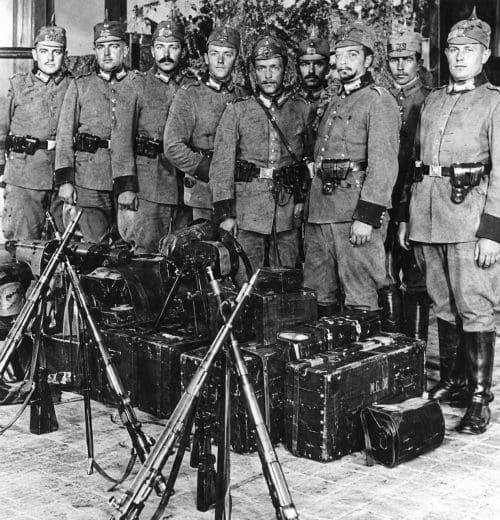
Turn to the Battalion itself using slide 5 and 6. Give the students this brief piece of background knowledge and then go straight into the mystery itself. You will find a set of cards (see downloadable and sample page) which you may want to adapt for your particular class. The idea is that they have to consider the value of the information on each card. Do they think that it exerted a strong or weak influence on the Battalion members? They start by reading the cards, taking it in turns, within their group of 3. They then discuss each and place it on a spectrum using the grid provided (see downloadable).
Step 4
When most have processed the information, ask for each group’s three most influential cards.
Step 5
At this stage the students may feel that they have cracked the issue. This is deliberate, for it is at this stage that we want them to think even deeper. New evidence has come to light, revealed to the students using the 6 slides 10-15.
Step 6
Having seen this information for the first time, students will need to reflect on whether this changes their opinion. It is helpful if you print out the slides either 6 per page or 1 different one for each of the group members. Give a few minutes for the significance of the new evidence to be assimilated.
Step 7
Collect in any changed opinions. Students invariably like to know if they are right, so share with them slide 16 which is one historian’s recent view, Christopher Browning’s, from his book ordinary men; Reserve Police Battalion 101 and the Final Solution in Poland (New York, 1993).
Step 8
Briefly tell them what happened to some members of the Battalion and ask for their reaction. If time you might want to draw out the significance of the episode. What light does it shed on the Nazi regime?
Plenary
In the pairs they have been constructing the line of significance, pupils are asked where they stand on the issue, literally. One of the pair moves to stand below a photo of Browning and or Golghagen (slide 15 and 16)which have been placed at either end of the room. Then the seated pupil of the pair has to explain why their partner is standing where they are.
It may be useful to bring up Goldhagen’s Jewish roots to raise the question of whether this is really just about weighing the evidence. Also the fact the Browning was called by David Irving as a witness at his trial, only to turn out as one of the most useful witnesses against him.

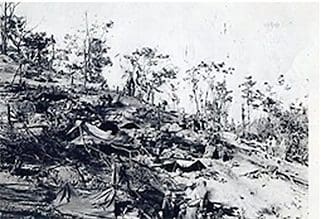
© image above USHM United States Holocaust Memorial Museum
The author has made every effort to obtain permission to reproduce copyright material throughout the site. if any proper acknowledgement has not been made , or permission, not received, would the copyright holder kindly inform us of this oversight so that the necessary arrangements be made.