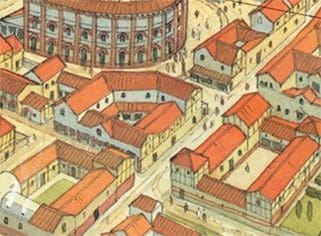
After re-capping the main features of Iron Age settlements, pupils work collaboratively in role as spies trying to find which special buildings the Romans had in their towns. They then research each before attempting to create a large sugar paper drawing of the plan of a typical Roman town. Pupils are helped to get started by showing them a pre-prepared one quarter of the plan. They have to finish it. Ideas and extra resources are fed in throughout the activity before using clear artists’ impressions to offer expert feedback.
Learning objectives
- Children are able to see which the most significant changes would have been e.g emergence of towns and villas in countryside.
- Children grasp how sophisticated Roman lifestyle was for rich, e.g: evidence Fishbourne (about palaces and villas) and from Silchester (about towns).
- Children understand range of entertainments that Romans had in society – amphitheatres, baths and forum.
- They understand that society was diverse and that poor lived very differently.
- They understand the nature of evidence from Roman times e.g. remains of buildings, coins, written descriptions, objects such as tesserae, bones, oil lamps.
The session starts by asking pupils what a typical Iron Age settlement looked like using slides 2 and the picture on slide 3 of the PowerPoint presentation to help. Slide 4 then checks that all the key points from slide 3 have been found, before slides 5 and 6 recapitulate.
Slide 7 then introduces pupils to a typical Roman town that soon grew up after the invasion of AD43. Towns very soon became a feature of the Roman British landscape as the Romans needed to make the conquest stick, and stick quickly. Towns were key. They were the administrative centres from which the provinces could be run, controlled and provided with markets, industries and trade. Towns were essential to Roman civilization and they were never built on Iron Age hill forts. In all there were probably 25 specially built new towns, some like Verulamium (St.Albans), home to a population as large as 15,000.
Use slide 7 to set the challenge. Pupils have to create a large sugar paper plan of a typical Roman town for which they top right hand side has been done for them. They need to do some research. To make this motivating place pupils in the role of spies from the native Britons who have heard about these fabulous towns and want to see if its all true. They can’t visit though or they might be captured by the Romans.
Around the room are secreted 12 cards with the names of 12 separate buildings that the Roman towns would have had. These are provided as RS1. You will need to copy them onto card (print the easy ones on green and harder ones on red – see differentiation below), cut them up and hide them around the room. The pupils’ first job is to find them. Like all good spies, they must not be caught with any incriminating information on them so they must NOT take the cards away. They must look carefully at them, lock the contents in their memory and then report back what they discovered. It is really important that you stress the need to memorise. eg. card 3 mentions main streets, but crucially adds that they ran North-South and East-West. This detail is crucial.
Guidance to feed into pupils
Towns were laid out in square or rectangular shape with 2 main axes: one running north south; the other east-west. Protecting the entrances were four main gates. That’s all we are going to tell the pupils. They are then shown slide 7 which is just a small part of an artist’s reconstruction. What pupils have to do, working in groups of 3 with a large piece of sugar paper, is to find out:
- What buildings would have been in a typical Roman town?
- Where in the town would they have been built?
- What did they look like?
Differentiation
Throwing down this challenge will hopefully fire all pupils’ imagination but it might seem daunting to some. To help those who would benefit from a little more structure and direction, hide the names of 9 of the most prominent buildings around the classroom on different coloured card and ask pupils who would benefit from a simpler start to focus just on these. The list below suggest which 3 might be held back initially to be fed in later.
The cards mention:
- Baths
- Shops
- Streets and their directions
- Temples (harder)
- Chariot circus track
- The basilica (harder)
- Amphitheatre
- Forum (harder)
- Town walls
- Main gates
- Shape of the town
- Aqueducts
The main drawing task
When they have the buildings they need to decide as a team, working collaboratively, where they should be drawn within the town walls. This research should focus on the physical appearance of the town, using slide 7 as a model. You will need to make sure that pupils have good access to textbooks and suitable internet sites.
When they think they have finished ask them to spy on each other’s plans to see if they can steal any good ideas from them – they love this bit! When all final diamond-polishing has taken place, its time to get feedback. Ask representatives from selected groups to talk through their designs, but keep this snappy.
Slides 8 and 9 can be used to feedback during or after the pupils’ drawing activity inviting pupils to add further detail to their own.
NB Slides 10 and 11 of the PowerPoint are provided as extra resources to consult during the drawing phase.


| All Key Questions | Historical focus |
|---|---|
| KQ1 Part 1 – From Caesar’s invasions to Claudius’ conquest | Chronology and conquest |
| KQ1 Part 2 – Why did the Romans invade Britain? | Causation |
| KQ1 Part 3 – The Roman invasion: have the books got it right? | Evidence and interpretations |
| KQ2 Part 1 – Should the Celts take on the Romans? | Military power and decision-making |
| KQ2 Part 2 – Boudicca’s rebellion | Resistance, causation and consequences |
| KQ2 Part 3 – What image do we have of Boudica today? | Historical interpretations |
| KQ3 – How were the Romans able to keep control over such a vast empire? | Power and control |
| KQ4 Part 1 – What can we learn from a Roman town? | Settlements and everyday life |
| KQ4 Part 2 – Is this another Roman villa? | Archaeological evidence |
| KQ5 – How can we solve the mystery of why this great 400-year empire suddenly came to an end? | Causation and change |
| KQ6 – What have the Romans ever done for us? | Legacy and significance |