Varied introduction to the Moon Landing topic with pupils actively involved in sequencing, speculating and then the killer activity called Prove it in which they have to use a gallery of visual clues to find evidence to prove that man really did go to the moon.
Learning objectives
- Pupils can combine clues to infer what the mystery picture might be.
- Pupils are able to make links between the astronauts and other pioneers of flight.
- Pupils can place the First Moon Landing approximately on a timeline of the last 100 years.
- Pupils are able to consider the type of evidence available to historians studying the Moon landing of 1969.
- They can match statements to specific pieces of evidence.
- Pupils understand that people are sceptical as to whether it ever happened and know some reasons why (flag, footprint etc)
Step 1
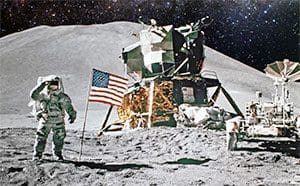
If you haven’t already told the pupils what their new topic is to be, try introducing it using slide 1 which is animated to act as a slow reveal (slide 1). As each of the four covering coloured squares disappears on clicking, so more of the image of man on the moon is revealed. Discuss how they knew this was man’s first moon landing.
Explain that this was in 1969, nearly 50 years ago, and was the first time man had ever set foot on the moon. We are going to find out how the astronauts got there and back and what they did while they were on the surface of the moon. We are also going to ask how we know that this really happened. But first we are going to look at the story of how man first started to fly.
Step 2
Give pupils, working in groups of 3, copies of slides 9-14 (labelled A-F) copied 6 per page and cut up and placed in envelopes. Ask them to work out which they think is the earliest attempt at flight and then place the rest in chronological order.
Dwell on slide 14 (E) which shows the Wright Brothers’ first powered flight in 1903. Reinforce the link between that and the first moon landing by showing the pupils slide 15. Explain that the visor of the space helmet was the one used for the first moon landing in 1969, but the reflection inside was added later. It shows the Wright brothers with their plane the Flyer in 1903. The spacemen are showing that it all started when man learned to use machines to power flight.
Step 3
Now move to Activity 3. Ask pupils to think how we would know if man had really been to the moon, and not just made up the story. You might like to use the prompts on slide 16 as a basis for discussion. Most should identify the selfie as the incorrect answer.
Step 4
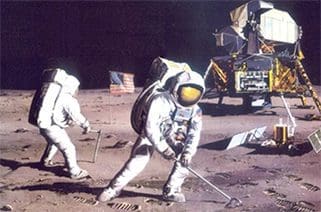
Now for the main activity 4, using the strategy known as Prove it! Pupils are given a set of statements (RS1) they have to find evidence for. To do this they will need to have a set of visual clues placed around the room as if it was an art gallery. These are provided as slides 3-8 ( i.e. clues 1-6 in the numbered in black circles. Working in pairs pupils have to complete the checklist. You will notice that there are two columns. This provides extension for the more able by asking them to find (sometimes) not only more than one clue but also to work out which is the best clue. RS1a gives you the answers.
Step 5
Having checked pupils’ answers orally, finish by explaining that some people still don’t believe that man ever went to the moon. It was all a fake. So issue the challenge to the pupils. With a hand-held microphone in your hand go to a range of pupils and ask them the same questions “What makes YOU think that man really did go to the moon in 1969?”


| Moon Landing Key Questions | Historical focus |
|---|---|
| KQ1 – Has man ever been to the Moon and how can we know for sure? | Historical evidence and enquiry |
| KQ2 – Why did the astronauts risk their lives going to the Moon? | Motivation and causation |
| KQ3 – How were they able to get to the Moon and back safely? | Technology and change |
| KQ4 – What did they do on the Moon? | Evidence and sequencing |
| KQ5 – Would you take the Golden Ticket and travel to the Moon? | Historical perspective |
| KQ6 – Commemorating the Moon Landing | Significance and commemoration |