In a recent article in Teaching History David Reynolds offers some clear insights into this period which might help to clarify issues for your GCSE students.
Firstly , he identifies three distinct , but overlapping, phases within the period 1989-1991:
Phase 1 (second half of 1989)
Collapse of communist governments across Eastern Europe
Phase 2 (1990)
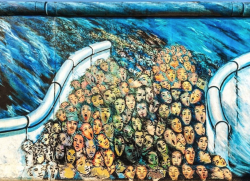
Focus shifted to Germany which was unified less than a year after the opening of the Berlin Wall
Phase 3 (December 1991)
Collapse of Soviet Union itself
Why did these dramatic events happen?
Reynolds offers the following explanations:
- Reason 1. It was the endgame of an outdated Soviet Command economy based on heavy industry. The Soviet bloc could not compete with the new service IT economy that mushroomed across the West in the 1980s. It was a race between Computers and collapse.
- Reason 2. ‘Star Wars’ finished off the Soviets.
Reagan’s Strategic Defence Initiative of 1983 demonstrated the technological gap between the superpowers. - Reason 3. Social shifts
1960s university-educated Soviet citizens were deeply sceptical of the old order. Also protest was spread across Eastern Europe by effect of the media, if not yet Facebook and Twitter, the importance of radios and TV cannot be under-estimated. - Reason 4. Vision of Gorbachev
Also his impatience and what Reynolds calls his naivete. His determination to break the hold of the military-industrial complex over the Soviet economy. His repudiation of the Brezhnev doctrine was important. As Archie Brown says: “The Gorbachev factor is integral to any explanation of the end of the Cold War.” - Reason 5. Diplomacy
Reagan and Gorbachev managed to sign the Intermediate Nuclear Forces Treaty in 1987 the first time that the superpowers had actually reduced their nuclear arsenals. Similarly the ‘summitry between Bush, Kohl and Gorbachev proved critical in effecting the unification of Germany”. To buy French support for German unification Kohl agreed to fast-track monetary union.