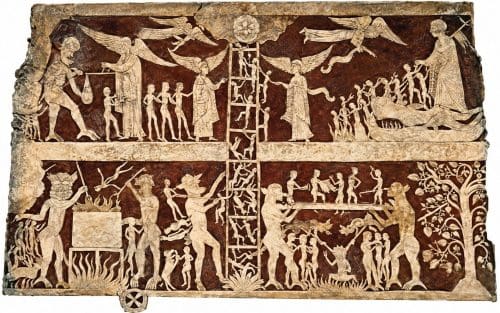
This innovative lesson uses the gallery strategy in which pupils compare a range of fascinating colour images to discover what Doom paintings have in common.
After annotating and captioning different individual scenes pupils compare their findings with text book summaries to see how much they have managed to work out for themselves.
Learning objectives
- pupils learn to observe closely and make deductions based on period knowledge of this Age of Faith
- pupils grasp reasons why doom paintings were produced
- pupils work out the main features of doom paintings by comparing a range of visual sources and detecting patterns for themselves
- pupils create an entry for Wikipedia and compare with the actual one, showing ability to synthesise
Starter
Using slide 2 on downloadable PowerPoint, presentation slowly reveal the church at Chaldon in Surrey, which is a marvellous example of a 12th century Doom painting, only discovered as recently as Victorian times. Slide 3 shows the picture, in situ, inside the church to give you an idea of scale.
Step 1
Now ask pupils to begin to speculate. Why do you think such a painting was produced inside a church? After studying in detail we can work it out.
Step 2
Show slide 4 and explain that each group of pupils is to take responsibility for one of the 7 areas of the wall painting. They have to provide a commentary, or animate a PowerPoint slide, whichever suits your teaching accommodation. To give them more confidence in their ability to achieve this task mention the clues on slide 6.
Step 3
When they have done that, reveal the captions that ‘experts’ have produced. (These follow each enlarged section of the picture and are to be found on slides 9,12,15,18,21,25 and 28). Pupils then have to annotate an A4 copy of slide 3 by placing arrows round the outside, as in slide 5. Pupils compare each others and self-assess.
Step 4
Now give pupils a little more background on doom paintings using slide 30. Then tell the pupils it is their turn to write 10 sentences about doom paintings, but they have to work them out for themselves based on 7 images they will be given. Place on the classroom walls, well spaced apart as if in a picture gallery, 7 doom paintings, included as slides 33-40. Pupils have to work out what they each have in common, by making notes on a clip board as they move between pictures. Try to avoid bunching by having them start at different points. If wall space is limited then put them on tables and have pupils move sensibly between them. If you are doing that, then I suggest a couple of copies of each image so pupils aren’t waiting for their turn to look. If your room is cramped organise a simple way of pupils passing the images in clockwise direction from table to table.
Step 5
Now ask them to come up with 10 images that they think are found in most doom paintings. They could be given an easy start with the hint, ‘two begin with the letter H’. The idea is that they should look for patterns. The more able will love the challenge and be capable of working fairly independently, allowing you time to support the lower-attaining pupils.
Step 6
What should emerge from studying 7 in detail are the following points:
- Heaven
- Hell
- Angels
- Archangel Michael
- Scales
- Demons
- Devil
- Monsters
- Chains
- Tied
- Dragged
- Chained
- Pain
- Burnt
They will, of course, have imaginative variations on these. The Wikipedia entry (see PowerPoint slides 42-4) is helpful as a form of checklist. Pupils get one point for every idea that Wikipedia included as shown in red, and 2 points for any fresh insights. This will act as motivation and also a challenge for the more able.
Plenary
In turns starting with one pupil of your choice, they have to describe one feature of the doom paintings. They then nominate another pupil who gives another feature until all ideas have been exhausted.
Resources
Additional visual resources
For close-ups of images of interiors and exteriors of medieval churches have a look at TimelinesTV which has 4 short pieces just a few minutes each. Simply move the timeline slider to along the top purple Changing lives section for the medieval period (between 1100 and 1200), the part called Medieval Minds.
Permissions
I am very grateful to Anne Marshall, former Associate Lecturer at the Open University, for giving permission for images from her excellent website to be used to resource this lesson and to her husband for taking the superb photographs.