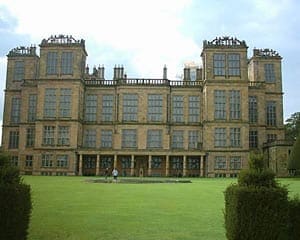
More glass than wall? Is this a fair description of Hardwick Hall? And how do we find out?
This SMART task links history with numeracy asking pupils to apply numeracy techniques to a famous historical building. Pupils are shown a photograph of an early Tudor building, the sort of house that existed before Hardwick Hall was built in the late 1590s. They don’t need to write anything, just absorb the detail. The image slowly disappears from view as the new image showing the front elevation of Hardwick Hall fills the screen. Wow! If people in Tudor times hadn’t seen this before, what would they think was so special about it?
Pupils can have a copy of both images so they can discuss the main comparisons. Again they don’t need to write. The house was described as being more glass than wall. But is this true? Can we use our numeracy knowledge to work it out? Lots of opportunities for discussion of lines of symmetry and coming up with different creative methods of measuring. Since this lesson was published a great new resource has become available.
Although designed for GCSE students studying Hardwick hall the video itself contains 3 minutes of very clear, high-quality close-ups and animated graphics which are perfect for Y4/5 pupils.
How could pupils use their numeracy strategies? Ask them to work in groups to think of the best method for working out if there was more glass than wall. See if the year 4/5 pupils start thinking about lines of symmetry. What about methods of calculating within one half of the picture? How could this be done? Could you use a piece of acetate marked off as a grid and see in how many of the grid’s squares there is more glass than wall. This might be a quick way but is it entirely accurate? What are the weaknesses of this method? What alternatives can they suggest?
At the end of the feedback on the strategies they used and the conclusions they came to, you may want to discuss the building’s other features briefly including Bess of Hardwick’s ES initials on the tower. A few background notes are included on the accompanying PowerPoint Presentation.
Resources
| All Key Questions | Historical focus |
|---|---|
| KQ1 – Henry VIII: Could you spot Henry VIII in a police line-up? | Historical interpretations |
| KQ1 Part 2 – Interpreting Henry VIII | Historical interpretations |
| KQ2 – Why did Henry break with Rome? Love or religion? | Causation and religion |
| KQ2 Part 2 – The highs and lows of Catherine of Aragon | Chronology and personal experience |
| KQ2 Part 3 – Making sense of a letter from Henry VIII to Anne Boleyn | Primary source evidence |
| KQ3 – How different was life for people at different levels of society in Tudor times? | Similarity, difference and society |
| KQ3 Part 2 – More glass than wall? A Tudor enquiry | Evidence and Tudor society |
| KQ4 – Elizabeth I portraits: why aren’t things what they seem? | Evidence, propaganda and interpretation |
| KQ4 Part 2 – Get ready: the Queen is coming! | Power and authority |
| KQ5 – How was the Spanish Armada defeated by the smaller English fleet? | Causation and conflict |
| KQ6 – How did people enjoy themselves in Elizabethan England? | Everyday life and culture |