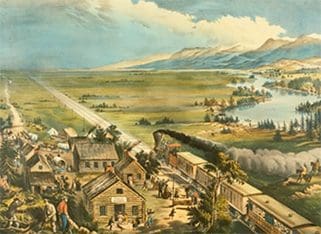
This history puzzle focuses on a well-known painting, Across the Continent, but one which is actually more puzzling than might at first appear.
The task starts simply and then becomes complex. Initially, all students have to do is to annotate a copy of the 1868 painting of a frontier town (using PowerPoint slide 6 as the template). Their task is to find 10 significant items in the painting, ones the artist would definitely have included for a reason. If some students need help with this, you might offer them a copy of PowerPoint slide 7 which has 10 numbered items already identified. I would be inclined to give them free rein to start with and introduce this page only if they get stuck. Having it as a slide or a paper copy gives you the flexibility of using it with the whole class or just with individuals.
The second part of the task is to work out what the reason was why each item was included. These answers are added to the template on PowerPoint slide 6, this time using the outer part of the frame on which to record their thoughts and inferences.
Possible answers are provided on PowerPoint slides 8, 9 and 10 which are provided to speed up feedback. Take students ideas first, of course, with slide 7 displayed and use the ideas on slide 8-10 simply to reinforce or plug any gaps. The answers provided are just one set of inferences. There may well be others, of course.
The last phase of the lesson returns to the central puzzle (shown on slide12). On the train featured in the painting are written the words Through New York to San Francisco, but the painting was produced in 1868, a year before the first line was actually opened in 1869. How could this be? Ask students to speculate how this could be possible.
If you want to narrow down their thinking, or give help to those who need some support, offer the four possible explanations provided on slide 13. Students have to rank them in terms of how likely they are as an explanation. The activity is about creative thinking not finding the one right answer. Your talking through the four options and your response to them will help their metacognitive thinking, so be sure to explain how you came to your conclusions.
Slide 14 gives the contextual detail that you need when debriefing the activity. Students will expect the right answer from you. Stress that some are more likely than others that is why you asked them to be ranked not simply to select just one ‘right’ answer.