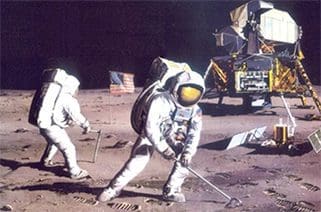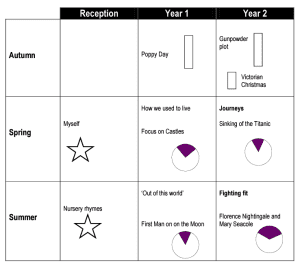
Curriculum models for KS1 historyIt seems a logical extension of the advice on long-term planning of the curriculum to offer you some models of what it might look like. As you know, the devil is in the detail. With the current emphasis firmly on a more cross-curricular approach there is a temptation to ditch all the old topics and start from scratch in an innovatory way. I am as keen as any one to encourage more imaginative design, but we just need to reassure ourselves that we are gaining more than we are losing. It may well be that you are wiser to still treat some aspects of the history Programme of Study separately from the on-going topic. This may be particularly true of the famous people and events section. If they don't fit, don't force them. There's nothing wrong in ending the main topic a week early and then having an intensive burst of history linked closely to literacy. To help you with your thinking about the best way of incorporating history into your new topics, I have presented you with 6 models. They are not meant to have any particular status other than to provoke debate. You will probably find yourself liking parts of some models, and none of others. This may have the effect of strengthening your belief in what you are currently planning - which is great. If it does nothing else this section should encourage you to firm up your rationale for your curriculum choices. Beads on a necklace: a few words about cross-curricular planningWhen planning for history within a broad cross-curricular topic, you are well advised to consider the following key points: Key point 1 Key point 2 Key point 3 Key point 4 Key point 5 For a lively example of how subjects might be linked in terms of Man's First Moon Landing topic, you might enjoy looking at the PowerPoint presentation in the downloadable section Where are schools now?Not all schools have embraced a fully cross-curricular approach yet, and examples of really best practice that do justice to history are hard to come by. What I show below is a range of different ways of organising history on the curriculum. A quick glance at each will show the way the curriculum is moving. You will find a symbol next to each topic which represents the length of time given over to the history within that topic. Below each model there is my commentary. What the symbols mean? A star means light coverage, interesting because it relates to the past (e.g. a story) but no attempt to deepen historical understanding A long thin vertical rectangle indicates a topic of very limited duration e.g. an anniversary such as Poppy Day. History work confined to a couple of sessions over the few days the short topic runs for. Probably linked to assembly in some way. A long thin horizontal rectangle indicates a history-led topic taught for at least half a term, with some recognisable history each week, but taught in small time slots not intensively. A square block indicates a more intensive history-led topic where pupils are immersed in a period of the past. A coloured segment in a circle shows a cross-curricular approach with the coloured segment showing the proportion of time devoted to history. Some will necessarily be short and sweet, such as work on famous anniversaries. Others will show history as part of a long very integrated study. A third option might be a history-led topic linked to literacy where history is the dominant force and has the lion's share of the time. Model 1: Mixture of history-led and integrated Model 2: Stronger Year 2 provision Model 3: Relying (too much) on QCA modules Model 4: Ringing the changes with famous people and events Model 5: Strongly cross-curricular Model 6: Successful integration? Please note that as more examples of good practice emerge, so they will replace the examples shown here. If you have a really good example you'd like to share, please make contact. We hope you found this free sample helpful. If you would like to access hundreds more teaching resources like this for KS1, KS2, KS3 and KS4 for just £49.95 for 1 year unlimited access Subscribe now, or view more free samples |
|
||||||